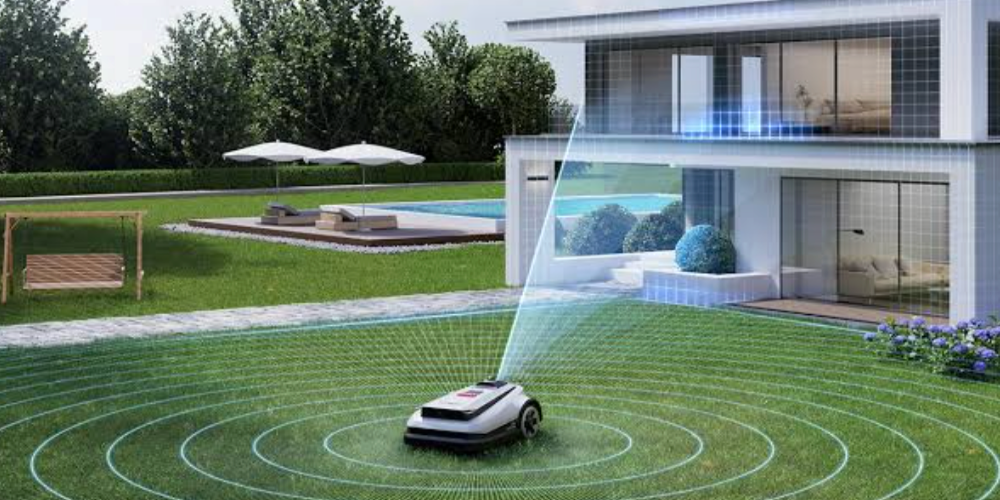
If you're shopping for a modern robot lawn mower, you've probably come across terms such as RTK, LiDAR, 3D-ToF and AI navigation.
They sound impressive — but what do they actually mean?
RTK and LiDAR are two of the technologies that allow the latest robot lawn mowers to navigate gardens accurately without relying on the traditional boundary wires used by older robotic mowers.
Both can provide highly intelligent, precise navigation, but they work in very different ways.
In this guide, we'll explain RTK vs LiDAR robot lawn mowers, how each navigation system works and which type might be better suited to your garden.
RTK vs LiDAR at a Glance
| Feature | RTK Robot Lawn Mower | LiDAR Robot Lawn Mower |
|---|---|---|
| Main navigation method | High-precision satellite positioning | Laser-based environmental mapping |
| External reference station | Generally required for RTK models | Not required for LiDAR-only navigation |
| Physical boundary wire | Not required on compatible wire-free models | Not required on compatible wire-free models |
| Uses digital mapping | Yes | Yes |
| Satellite visibility | Important | Not the primary positioning method |
| Trees/buildings | Can affect RTK signal | Less dependent on satellite visibility |
| Navigation in darkness | Additional sensors may vary by model | LiDAR itself does not depend on visible light |
| Best suited to | Gardens with suitable satellite reception | Complex or enclosed garden environments |
What Is RTK on a Robot Lawn Mower?
RTK stands for Real-Time Kinematic positioning.
It's a high-precision form of satellite positioning that can provide much greater accuracy than standard GPS.
A conventional GPS device might know roughly where it is. That's perfectly adequate when your phone is trying to tell you which road you're driving along.
A robot lawn mower needs considerably greater precision.
It needs to know whether it's safely inside the lawn, approaching a boundary or following a planned mowing route.
RTK improves satellite positioning accuracy by using correction data from a fixed reference station.
The result is a positioning system accurate enough to help a compatible robot mower navigate a digitally mapped lawn without requiring a traditional perimeter wire.
How Does an RTK Robot Lawn Mower Work?
An RTK robot lawn mower communicates with satellites and an RTK reference station.
Together, these provide the accurate positioning information the mower needs to understand where it is within its mapped mowing area.
Modern systems don't necessarily rely on RTK alone.
For example, the ECOVACS GOAT O600 RTK combines RTK positioning with an AI camera through its TrueMapping 2.0 Multi-Fusion RTK Navigation system.
The ECOVACS GOAT O800 RTK goes further, combining RTK with camera technology and 3D-ToF sensing in its LiDAR-Enhanced RTK Navigation system.
This combination of technologies allows the mower to use additional environmental information alongside its satellite positioning.
Does an RTK Robot Mower Need a Boundary Wire?
Not if it has been designed for wire-free operation.
Models such as the ECOVACS GOAT O600 RTK and O800 RTK use digital mapping and virtual boundaries rather than requiring a traditional physical perimeter wire around the entire lawn.
However, RTK shouldn't be confused with having no external equipment whatsoever.
An RTK mower typically requires a reference station or antenna, which must be positioned appropriately so that the navigation system can operate correctly.
That's very different from installing a wire around the entire garden, but it is an important distinction when comparing RTK with LiDAR.
What Is LiDAR on a Robot Lawn Mower?
LiDAR stands for Light Detection and Ranging.
Rather than determining its position primarily through satellite signals, LiDAR uses laser pulses to measure the mower's surroundings.
The system sends out laser signals and measures how long they take to return after reflecting from objects in the environment.
By taking huge numbers of these measurements, the mower can build a detailed understanding of the space around it.
If you've used a high-end robot vacuum cleaner, you may already be familiar with the idea. LiDAR is widely used to help robot vacuums map rooms and understand where walls, furniture and other features are located.
A LiDAR robot lawn mower applies similar principles outdoors.
How Does a LiDAR Robot Lawn Mower Work?
LiDAR continuously measures the surrounding environment and uses that information to determine the mower's position within its mapped area.
Advanced systems can combine more than one type of LiDAR sensor.
The ECOVACS GOAT O1200 LiDAR PRO, for example, uses HoloScope 360 Dual-LiDAR Navigation.
This combines a 360° rotating LiDAR with 3D-ToF LiDAR to create a detailed map of the garden and provide highly accurate navigation.
The GOAT A1600 LiDAR PRO also uses Dual-LiDAR technology for advanced wire-free navigation.
Unlike the RTK-equipped GOAT O600 and O800, the LiDAR PRO models don't require an external RTK reference antenna for navigation.
Does LiDAR Need GPS or Satellites?
LiDAR itself does not rely on satellite positioning to understand the mower's surroundings.
That's one of the most important differences between RTK and LiDAR.
An RTK system depends on satellite-based positioning and correction information.
LiDAR instead measures the physical environment around the mower.
This can make LiDAR particularly interesting for gardens where buildings, mature trees or other structures could make reliable satellite reception more challenging.
Do Trees Affect RTK Robot Lawn Mowers?
They can.
RTK relies on receiving suitable satellite signals, so anything that significantly obstructs the view of the sky has the potential to affect positioning.
That can include:
-
Dense tree cover
-
Tall buildings
-
Walls
-
Covered areas
-
Other significant overhead obstructions
Modern RTK robot mowers can use cameras and additional sensors to help maintain navigation when conditions become more challenging.
For example, compatible ECOVACS GOAT RTK models can use visual sensing to supplement positioning in areas where RTK signal quality is reduced.
However, if your garden is heavily enclosed or surrounded by mature trees, navigation technology is something worth considering carefully before choosing your mower.
Does LiDAR Work Under Trees?
Because LiDAR doesn't rely on satellite visibility for its primary environmental measurements, trees blocking the sky don't affect it in the same way they can affect an RTK signal.
The mower is using laser-based sensing to understand its surroundings rather than depending primarily on its view of satellites above.
That can make LiDAR particularly attractive for complex gardens with mature trees, buildings or enclosed areas.
However, no navigation technology should be considered completely immune to environmental conditions. The layout and characteristics of your individual garden still matter.
Does LiDAR Work at Night?
Yes. LiDAR itself does not require daylight to measure its surroundings.
Because the system uses its own laser signals rather than visible light, it can continue to map and navigate in darkness.
For example, the HoloScope 360 Dual-LiDAR system used by the ECOVACS GOAT O1200 LiDAR PRO is designed to provide precise navigation even in the dark.
Other mower functions, particularly camera-based features, may still behave differently depending on lighting conditions.
Which Is More Accurate: RTK or LiDAR?
It's tempting to look for a simple winner, but accuracy isn't the only factor that matters.
Both technologies can provide extremely precise navigation when operating under suitable conditions.
ECOVACS states that its advanced RTK and Dual-LiDAR systems can provide positioning precision down to approximately 2cm on compatible models.
The more useful question is therefore:
Which technology is better suited to the environment in which the mower will operate?
An open garden with good visibility of the sky can be an excellent environment for RTK.
A more enclosed garden surrounded by buildings or mature trees may benefit from a navigation system that is less dependent on satellite reception.
What About LiDAR-Enhanced RTK?
This is where things become particularly interesting.
RTK and LiDAR don't have to be competing technologies.
They can also work together.
The ECOVACS GOAT O800 RTK uses LiDAR-Enhanced RTK Navigation, combining RTK satellite positioning with a 3D-ToF LiDAR sensor and AI camera.
RTK provides highly accurate global positioning within the mapped lawn, while the additional sensors help the mower understand what's happening immediately around it.
This hybrid approach provides another option between straightforward RTK navigation and the full Dual-LiDAR systems used by the LiDAR PRO models.
RTK vs LiDAR for Open Gardens
If your garden is relatively open, with good visibility of the sky and limited obstruction from large trees or buildings, RTK can be an excellent solution.
Models such as the GOAT O600 RTK and O800 RTK can create virtual lawn maps and navigate systematically without requiring a physical boundary wire around the entire lawn.
The additional cameras and sensors found on these mowers also help them recognise obstacles and respond to their immediate surroundings.
RTK vs LiDAR for Gardens with Trees
For a garden containing mature trees, particularly where tree cover significantly reduces visibility of the sky, LiDAR may become more attractive.
Because LiDAR navigation isn't primarily dependent on satellite positioning, it can use the physical environment around the mower to understand its location.
The same consideration can apply to gardens closely surrounded by tall buildings or other structures.
This doesn't mean an RTK mower can't work in a garden with trees. Modern multi-sensor systems can compensate for periods of reduced signal.
It simply means that satellite visibility should be considered when choosing an RTK-based mower.
RTK vs LiDAR for Complex Gardens
For complex gardens, navigation isn't just about knowing where the mower is.
The mower may need to deal with:
-
Multiple lawn areas
-
Narrow passages
-
Irregular boundaries
-
Trees
-
Buildings
-
Flower beds
-
Garden furniture
-
Slopes
-
Different mowing zones
Both RTK and LiDAR systems can support sophisticated digital mapping, but a Dual-LiDAR system can be particularly appealing where the physical environment itself is complicated.
The overall capabilities of the mower remain important too. Obstacle avoidance, cutting width, slope capability and narrow-passage performance should all be considered alongside the primary navigation technology.
Is LiDAR Better Than RTK for Robot Lawn Mowers?
Not automatically.
LiDAR isn't simply the newer or 'better' version of RTK.
They solve the navigation problem in different ways.
RTK can provide exceptionally precise positioning and is particularly effective in environments with good satellite visibility.
LiDAR can provide detailed environmental mapping without relying primarily on satellite reception.
The right choice depends on the garden.
RTK may be particularly suitable if:
-
Your garden has good visibility of the sky
-
You want precise virtual mapping
-
You're happy to install an RTK reference station
-
Your lawn is relatively open
-
You want wire-free navigation
LiDAR may be particularly suitable if:
-
Your garden is surrounded by buildings
-
You have significant mature tree coverage
-
Your garden has a more complex layout
-
You don't want an external RTK reference antenna
-
You want advanced environmental mapping
Which ECOVACS GOAT Uses RTK?
Within the current Foy's Electrical range:
ECOVACS GOAT O600 RTK
Uses TrueMapping 2.0 Multi-Fusion RTK Navigation with an AI camera and is designed for lawns up to 600m².
ECOVACS GOAT O800 RTK
Uses LiDAR-Enhanced RTK Navigation combining RTK, camera and 3D-ToF sensing and is designed for lawns up to 800m².
Which ECOVACS GOAT Uses LiDAR?
For customers looking for Dual-LiDAR navigation:
ECOVACS GOAT O1200 LiDAR PRO
Uses HoloScope 360 Dual-LiDAR Navigation and is designed for lawns up to 1200m².
ECOVACS GOAT A1600 LiDAR PRO
Uses advanced Dual-LiDAR navigation alongside a wider cutting system designed for lawns up to 1600m².
These models don't require the external RTK reference antenna used by the RTK versions.
What Else Should You Consider When Choosing a Robot Lawn Mower?
Navigation technology is important, but it shouldn't become the only specification you consider.
Before choosing a mower, also look at:
-
Recommended lawn area
-
Cutting width
-
Mowing efficiency
-
Cutting-height range
-
Maximum slope
-
Narrow-passage capability
-
Obstacle avoidance
-
Edge mowing or trimming
-
Multi-zone support
-
Charging and battery performance
-
App and mapping features
A sophisticated navigation system won't compensate for choosing a mower that's simply too small for your lawn.
Start with the size and layout of your garden, then use the navigation technology to help narrow down the best options.
RTK or LiDAR: Which Robot Lawn Mower Should You Buy?
For a relatively open lawn with good satellite visibility, an RTK robot lawn mower can provide extremely accurate, efficient wire-free navigation.
For a garden with more challenging satellite conditions, significant tree cover or surrounding buildings, a LiDAR robot lawn mower may offer advantages because it can understand its surroundings without depending primarily on satellite reception.
And for some gardens, a hybrid system such as LiDAR-Enhanced RTK provides an attractive combination of both technologies.
Ultimately, there isn't one navigation system that's right for every garden.
The best robot lawn mower is the one whose navigation technology, mowing capacity and overall features match the environment it actually needs to maintain.
Shop Robot Lawn Mowers at Foy's Electrical
Explore Robot Lawn Mowers at Foy's Electrical and compare intelligent wire-free mowing solutions for gardens of different sizes and layouts.
Choose from advanced RTK and Dual-LiDAR robot lawn mowers from ECOVACS, alongside other smart robotic lawn-care solutions designed to make maintaining your garden easier.